'One empty threat after another ': Federal Judge blocks ICE from re-detaining Kilmar Abrego Garcia
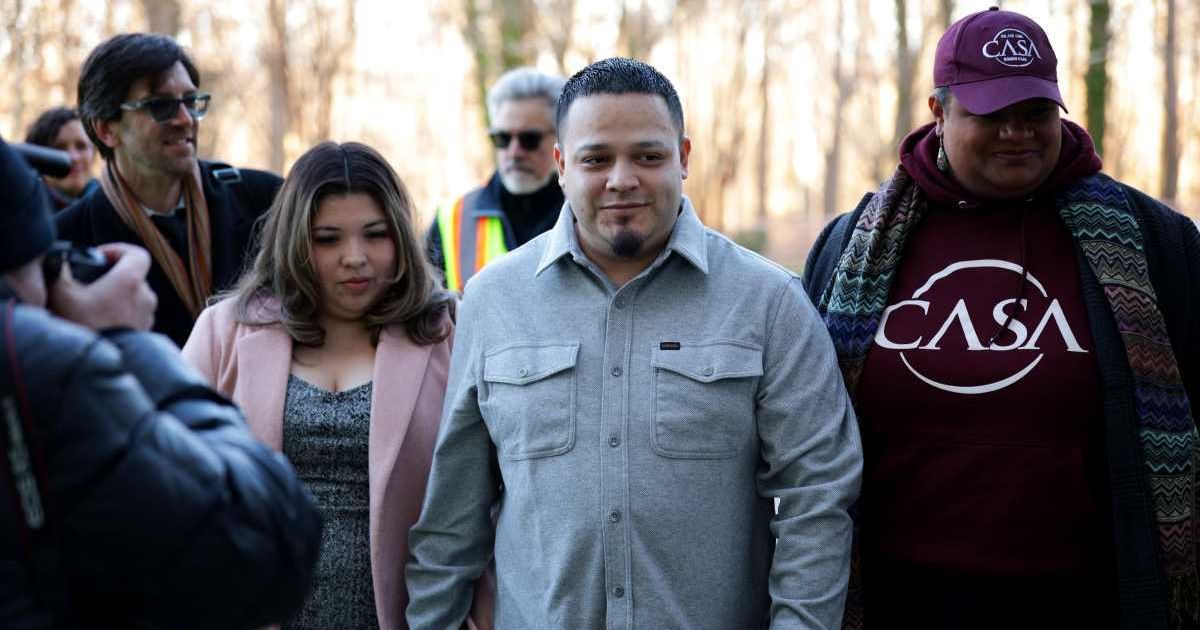
A Federal judge ruled Tuesday that the United States Immigration and Customs Enforcement (ICE) cannot re-detain Kilmar Abrego Garcia because his 90-day statutory detention period has expired. The Trump administration has "made one empty threat after another to remove him to countries in Africa with no real chance of success," U.S. District Judge Paula Xinis noted, adding, "From this, the court easily concludes that there is no 'good reason to believe' removal is likely in the reasonably foreseeable future."
Breaking news in Kilmar Abrego Garcia case. Judge Paula Xinis says law is on Abrego’s side and ICE cannot take him back into custody. pic.twitter.com/1hSyZGg9fg
— Paul Wagner (@paulcwagner) February 17, 2026
The ruling comes as a relief for Abrego Garcia, whose arrest and subsequent deportation to El Salvador's Terrorism Confinement Center (Centro de Confinamiento del Terrorismo or CECOT), a maximum security prison, grabbed the nation's attention. In an earlier ruling, Judge Xinis had called Abrego Garcia's deportation to El Salvador illegal and ordered the government to ensure his return to the U.S. "Although the legal basis for the mass removal of hundreds of individuals to El Salvador remains disturbingly unclear, Abrego Garcia's case is categorically different—there were no legal grounds whatsoever for his arrest, detention, or removal. Nor does any evidence suggest that Abrego Garcia is being held in CECOT at the behest of Salvadoran authorities to answer for crimes in that country. Rather, his detention appears wholly lawless," the judge had noted at the time.
Judge Paula Xinis on the government’s conduct in Kilmar Abrego Garcia’s civil suit:
— Anna Bower (@AnnaBower) December 11, 2025
“Respondents did not just stonewall. They affirmatively misled the tribunal.” https://t.co/oM1LpYA5FK pic.twitter.com/fZ3rnZ4h3e
'An administrative error'
During Abrego Garcia's hearing while he was under detention, the Trump administration acknowledged that his transfer to El Salvador was an "administrative error". In a court filing, the U.S. government mentioned that "although ICE was aware of his protection from removal to El Salvador, Abrego Garcia was removed to El Salvador because of an administrative error." However, since his release, the El Salvadorian immigrant has faced the Trump administration's ire, with ICE arguing that he is a member of the MS-13 gang. Proving Abrego Garcia's link to an illegal gang is key to the Trump administration's arguments in wanting to deport him. A month after his inauguration as President, Salvadoran president Nayib Bukele offered the US the use of CECOT to imprison criminal deportees of any nationality, including Americans, and after negotiations, agreed to imprison deportees at the high security prison for $6 million per year.
We have offered the United States of America the opportunity to outsource part of its prison system.
— Nayib Bukele (@nayibbukele) February 4, 2025
We are willing to take in only convicted criminals (including convicted U.S. citizens) into our mega-prison (CECOT) in exchange for a fee.
The fee would be relatively low for… pic.twitter.com/HTNwtp35Aq
On March 14, Trump invoked the Alien Enemies Act of 1798, which gives the president wartime authority to summarily arrest and deport citizens of a nation at war with or invading the U.S., and deported hundreds of Venezuelans and dozens of Salvadorans to be imprisoned in CECOT, claiming that they were gang members. While the Venezuelans, Trump said, were members of Tren de Aragua, the El Salvadorans were linked to MS-13. In Abrego Gracia's case, officials have pointed to a 2019 police report where detectives claimed his clothing—including a Chicago Bulls hat—and a confidential informant's tip "validated" him as an MS-13 member.
'Clear probability of future persecution'
As per reports, Abrego Garcia was sent to the U.S. when he was 16 years old by his family to protect him from the Barrio 18 criminal gang. His mother's pupsa (a street food) business had been a target of the gang. Barrio 18 members reportedly extorted money from her, threatening to force her eldest son, Caesar, to join the gang. Eventually, the family managed to pay the money and send Caesar off to the United States. When the gang threatened to kill Abrego Garcia, the family sent him to the U.S. as well.
In 2019, Abrego Garcia was detained along with three others found loitering near the parking lot of the Home Depot. During that time, an Immigration Judge's order expressly prohibited Abrego Garcia's removal to El Salvador because he faced a "clear probability of future persecution" there. Judge Xinis, too, had cited the order, stating, "In 2019, an immigration judge…granted Plaintiff Kilmar Armando Abrego Garcia ("Abrego Garcia") withholding of removal…Such protection bars the United States from sending a noncitizen to a country where, more likely than not, he would face persecution that risks his "life or freedom.""